
Europe’s Hidden Gems You Should Visit Before Everyone Else Does
Venice caps day-trippers at the gate. Barcelona residents have taken to spraying tourists with water guns. Cannes now turns away any cruise ship carrying more than 1,000 passengers, a rule that took effect this January. Hallstatt, the Austrian lake village that became an Instagram fixture, saw its own residents block the road into town last summer, holding signs that read “radical frontiers for mass tourism.”
None of this is news to anyone who has tried to book a hotel room in Dubrovnik in July. What’s newer is where the overflow goes. As the continent’s marquee destinations impose caps, fees, and outright bans, a second tier of towns, ones that spent the last decade in the shadow of their more photographed neighbors, are absorbing the interest and, in several cases, using it to fund the kind of restoration work that never had a budget before. A gallery in Piran reopened this February after eighteen months of facade work. Albarracín’s medieval walls have new sections open to walkers for the first time in years. Matera spent 2019 as European Capital of Culture and is now, in 2026, the Mediterranean Capital of Culture and Dialogue, a second act most cities never get.
The eight towns below aren’t secrets. Several have been written about for years. What’s changed is timing: each has a specific, dated reason to go in the next twelve months, before the pattern that hit Hallstatt and Kotor repeats itself somewhere else.
Piran, Slovenia
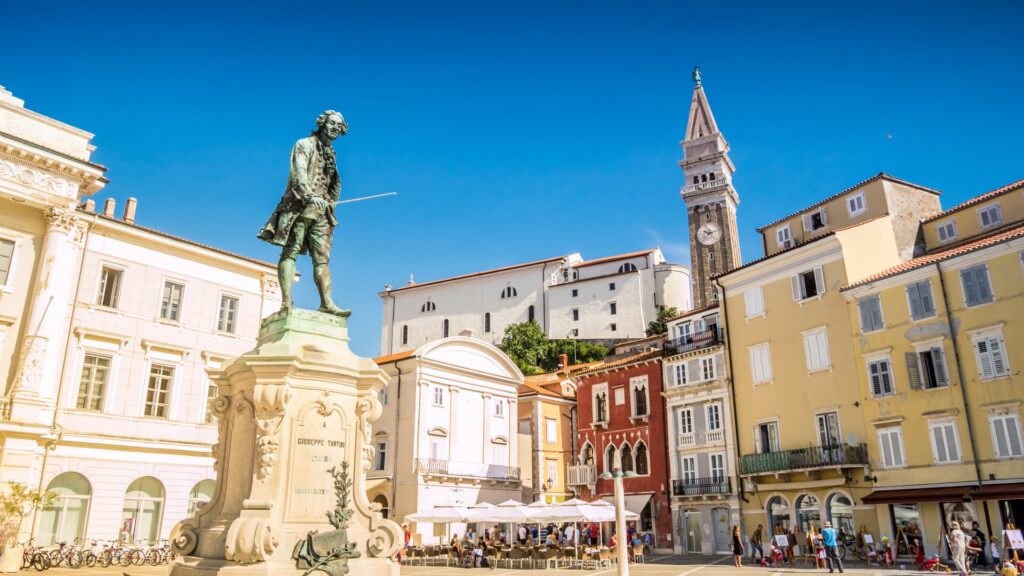
Piran sits on a narrow peninsula on Slovenia’s short stretch of Adriatic coast, a Venetian holdover with the same salt-washed stone and shuttered windows you’d find across the water in Italy, minus the crowds and, for now, the prices. The town produced the violinist and composer Giuseppe Tartini, whose statue anchors the central square that bears his name, and it still draws its salt from the Sečovlje pans a short drive south, worked by hand using methods that haven’t changed much since the Middle Ages.
The reason to go this year is smaller and more specific than the town itself. The Herman Pečarič Gallery, closed since September 2025 for a full restoration of its facade and interior, reopened in February with a broader hang of the Pečarič collection than the space could previously show. Later in the year, in November, the Piran Civic Gallery hosts the first retrospective of Jasmina Cibic, whose new film was shot partly at a hydroelectric station on the Soča River and deals with the politics of aesthetics along the Adriatic border, a subject that could hardly be more local to where it’s showing. Neither event will pull the crowds that a Venice biennale does, which is precisely the point.
Base yourself in the old town if you can afford the short walk to everything; Piran is small enough that a car becomes a liability rather than an asset. Late spring, before the Slovenian and Italian coasts fill up in July and August, is the easiest time to get a table at any of the seafood restaurants along the harbor without a wait.
Albarracín, Spain
Albarracín’s houses run the color of dried blood, an effect of the iron-rich local stone that has made the town a fixture on “most beautiful villages in Spain” lists for decades without ever quite becoming crowded. It sits in the mountains of Aragón, capital once of an independent taifa ruled by the Berber Banu Razin dynasty in the tenth and eleventh centuries, which is where the name comes from. Toledo and Ronda get the tour buses. Albarracín, three hours from Madrid on roads that discourage day-trippers, mostly doesn’t.
The Fundación Santa María de Albarracín, which has spent years restoring the town’s Cathedral and its Flemish tapestries, opened new sections of the medieval walls to visitors in 2026 and improved the trail signage into the Sierra beyond. The tapestries themselves are worth building a visit around: local historians rank the Cathedral’s collection among the three most significant sets of Flemish tapestry in Spain, alongside those held at the Royal Palace in Madrid and La Seo in Zaragoza, and the restoration work means they’re now displayed and lit properly for the first time in years.
Two days is the right amount of time here, one for the walls and the historic quarter, a second for the Pinares de Rodeno just outside town, a landscape of red sandstone and prehistoric rock art that most visitors to Albarracín never make it to. Accommodation is limited by the size of the village, so book ahead for weekends regardless of season.
Dinant, Belgium
Dinant runs along a single strip of riverbank squeezed between the Meuse and a wall of limestone cliff, with a citadel fortress on top that has watched over the town, in one form or another, since 1051. It’s an hour and a half from Brussels by car or train, which makes it an easy day trip and an easier reason to skip it in favor of Bruges. That’s a mistake for anyone who cares about jazz: Dinant is the birthplace of Adolphe Sax, inventor of the saxophone, and the town has built an identity around that fact that goes well beyond a statue.
This July, the Dinant Jazz Festival turns twenty-five, and for the first time in its history it’s partnering directly with the Citadel after winning a regional “Heritage in Show” grant. The festival opens July 23 with a concert inside the fortress walls, followed by two mornings billed as a “Gourmet Awakening at the Citadel,” breakfast and live music with the Meuse valley laid out below. It’s a small, specific collision of heritage site and music festival that most European cities never manage to pull off, largely because most cities don’t have a working eleventh-century fortress sitting empty for the rest of the year.
Take the cable car up to the Citadel rather than the 408 stone steps unless you want the workout, and pair the visit with the Collegiate Church of Notre-Dame below, one of Belgium’s better-preserved Gothic landmarks and a five-minute walk from the jazz festival’s riverside stage.
Kotor, Montenegro
Kotor is the complicated one on this list, and it deserves to be treated as such rather than sold as an undiscovered secret, because it isn’t one. Roughly 500 cruise ships call at the town in a given year, and on the busiest days as many as four vessels dock at once, putting close to 15,000 people through streets built for a population of 23,000. Locals have pushed for years to raise the one-euro entry fee cruise passengers pay and to cap ship arrivals outright, following the lead of Cannes, which banned any cruise ship over 1,000 passengers starting this January.
None of that erases what makes Kotor worth the trip: a walled Venetian old town set against a fjord-like bay that James Bond fans will recognize from Casino Royale, with a fortress wall climb above town that delivers one of the more dramatic views on the Adriatic coast. The honest advice, and the reason Kotor still belongs on a list like this, is about timing rather than discovery. Arrive before 9am or after 5pm and the old town empties out to something closer to what it looked like a decade ago. Better still, base yourself twenty minutes up the bay in Perast, a smaller Baroque town with two islands just offshore and none of the cruise traffic, and treat Kotor as a half-day excursion rather than a destination in itself.
May, June, and the first half of September are the months when the bay is warm enough to swim and the ships haven’t yet reached peak season volume.
Gosau, Austria
Hallstatt’s problem by now is well documented: a village of fewer than 800 residents absorbing roughly a million visitors a year, enough that locals blocked the access road last summer and, before that, put up a wooden fence specifically to block the view that made the town famous on Instagram (a fence that was itself removed after backlash). What gets left out of most of that coverage is that the Salzkammergut region Hallstatt sits in is full of towns doing the same lake-and-mountain trick without the daily coach convoys.
Gosau is the closest and easiest substitute. It sits under the same Dachstein massif, its meadows and farm hamlets running up to the Gosausee, a lake that reflects the glacier on a clear day about as well as Hallstatt’s does its church spire, minus the tour groups. In winter it’s a genuine ski base rather than a photo stop, with terrain that skews toward local traffic instead of international tourism. In summer, the hiking out of the village reaches alpine ibex and chamois territory within a couple of hours on foot, something Hallstatt’s crowded lakeside path can’t offer.
It’s roughly an hour from Salzburg by car, longer by the regional bus, and worth the extra planning it takes to get there without your own transport. Stay two nights if the schedule allows: Gosau rewards an early morning at the lake before the day-trippers from Hallstatt spill over, which, increasingly, they do.
Matera, Italy
Matera’s Sassi district, thousands of cave dwellings carved into limestone ravines and inhabited more or less continuously for nine thousand years, was also the site of one of modern Italy’s more shameful housing failures. Prime Minister Alcide De Gasperi visited in 1950, was appalled by the poverty he found, and ordered the entire population forcibly relocated to new housing in the upper town. The Sassi sat empty and decaying for decades until UNESCO listed them in 1993, the first heritage site named in southern Italy, and investment started flowing back in.
Matera used its momentum well: European Capital of Culture in 2019, and now, in 2026, Mediterranean Capital of Culture and Dialogue alongside Tetouan in Morocco, a title that runs the full year and centers on a program called Terre Immerse. The opening ceremony in March coincided with the reopening of the historic Duni Theatre, and April brought the reopening of the National Museum of Palazzo Lanfranchi with renovated galleries and new sections. Underground, the Palombaro Lungo, a cistern carved from bedrock in 1832 and tall enough to explore by boat, remains one of the more startling things to see anywhere in southern Italy, proof of the engineering that let people survive on a waterless plateau for millennia.
Matera isn’t undiscovered in the way Gosau or Dinant still is. It has appeared in two Bond films and a Wonder Woman sequel, and hotel prices in the Sassi reflect that. What’s worth timing around this year specifically is the Terre Immerse programming, which runs through December and brings performances, residencies, and exhibitions into the caves themselves rather than treating them purely as a backdrop.
Colmar, France
Colmar’s Christmas market is, by most rankings, one of the best in Europe, which is exactly why it’s the wrong reason to visit. The town spreads its market across six squares from late November through late December, and the crowds that come with that reputation are real. What the market coverage tends to bury is that Colmar earns its half-timbered reputation year-round, not just under string lights, and that the town produced Frédéric Auguste Bartholdi, the sculptor behind the Statue of Liberty, whose house is now a small, uncrowded museum near the center.
Go in late spring or early summer instead. Petite Venise, the canal district that anchors most of Colmar’s postcard photography, is walkable without a crowd at that time of year, and the Unterlinden Museum runs an evening sound and light installation in its old cloister that has nothing to do with the holiday season. The museum’s real draw is permanent: Matthias Grünewald’s Isenheim Altarpiece, a sixteenth-century work considered one of the more unsettling and technically extraordinary religious paintings in Europe, on display without the wait times a Louvre-caliber piece would draw anywhere else.
Use Colmar as a base for the Alsace Wine Route rather than a single-day stop. The 170-kilometer route through vineyard villages is close enough to manage as day trips by car, and Riesling and Gewürztraminer tastings along the way are, unlike the Christmas market, rarely booked out.
Mostar, Bosnia and Herzegovina
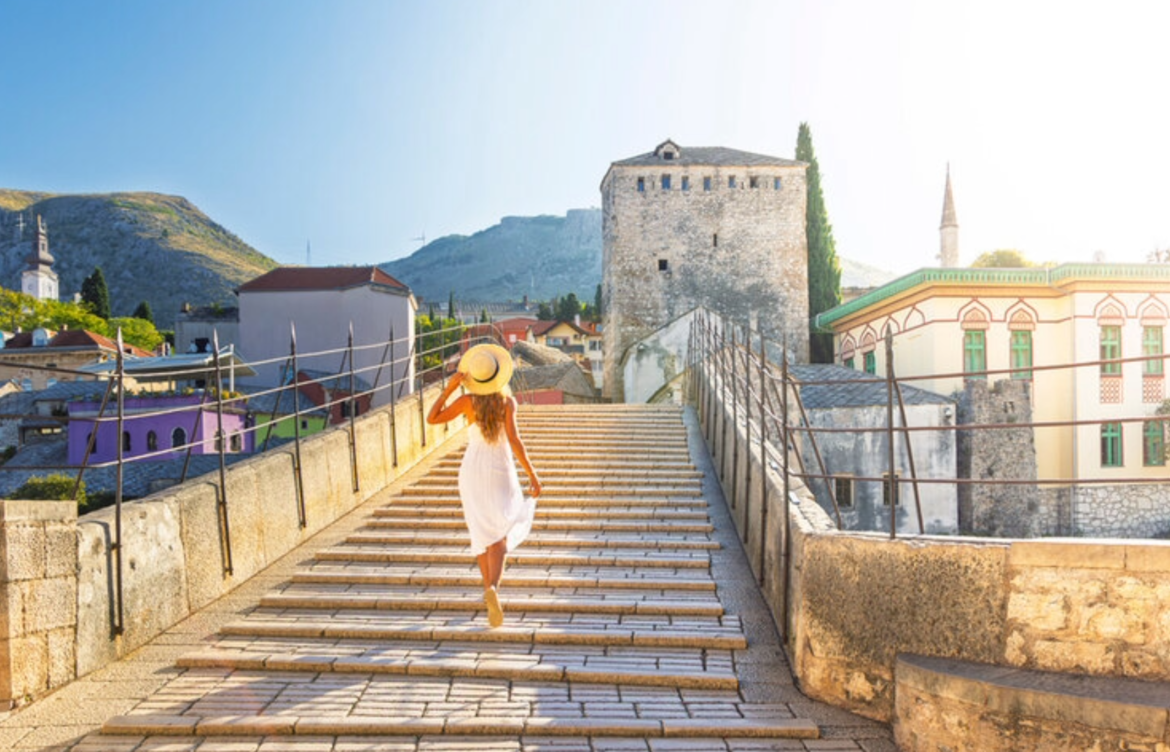
The Stari Most, Mostar’s Ottoman-era bridge, was destroyed by shelling in November 1993 during the Bosnian war, a deliberate act against a structure that had linked the town’s communities since 1566. Its reconstruction, completed in 2004 using original stones recovered from the riverbed and the same lime mortar and stoneworking techniques as the original, remains one of the more successful heritage restorations UNESCO has overseen, and the bridge was added to the World Heritage list the following year.
This year marks 21 years since that listing, and Mostar has used the anniversary cycle, each one commemorated with ceremonies drawing officials from across the region, to keep international attention on a town whose old bazaar and Ottoman quarter still get a fraction of the visitors that flow through Dubrovnik, two hours south. The bridge is also home to one of Europe’s oldest continuous sporting traditions: local divers have jumped from its parapet into the Neretva below in an organized competition for more than 450 years, a custom that predates the reconstruction by centuries and still runs every summer.
Stay a night rather than day-tripping from the coast; Mostar’s old town empties out noticeably after the last tour buses leave for Dubrovnik in the late afternoon, and the light on the bridge and the green Neretva water below it is better in the early evening than at any point during the day.
Planning the trip
Shoulder season does more work on this list than any single booking decision. Late April through early June and September into early October cover most of these towns at their best: warm enough for Kotor’s bay and Piran’s harbor restaurants, quiet enough that Albarracín’s guesthouses and Gosau’s lakeside cafes aren’t full.
None of these towns connect to each other especially well by train, so plan around regional hubs instead of a single continuous route. Trieste or Ljubljana airport for Piran, Madrid or Teruel for Albarracín, Brussels for Dinant, Dubrovnik or Podgorica for Kotor and nearby Perast, Salzburg for Gosau, Bari for Matera, Basel or Strasbourg for Colmar, and Sarajevo or Dubrovnik for Mostar. A rental car earns its cost on this itinerary more than a rail pass would: several of these towns, Albarracín and Gosau especially, are meaningfully harder to reach without one.
More on slow, considered travel across Europe and beyond is at The Chica Travelista.